By submitting, you consent to our use of your data. Privacy Policy.
Category
Financial Services & Banking
Built by
Beam.ai
Wave Accounting is an accounting platform for small-business finance teams, organized around businesses, customers, invoices, products, and payments. The vendor documentation defines the resource model and required permissions. Treat the transaction or approval as the review surface, and preserve the audit trail rather than hiding it behind automation. Use the Beam catalogue entry as a starting point, then confirm connector actions and event coverage before rollout
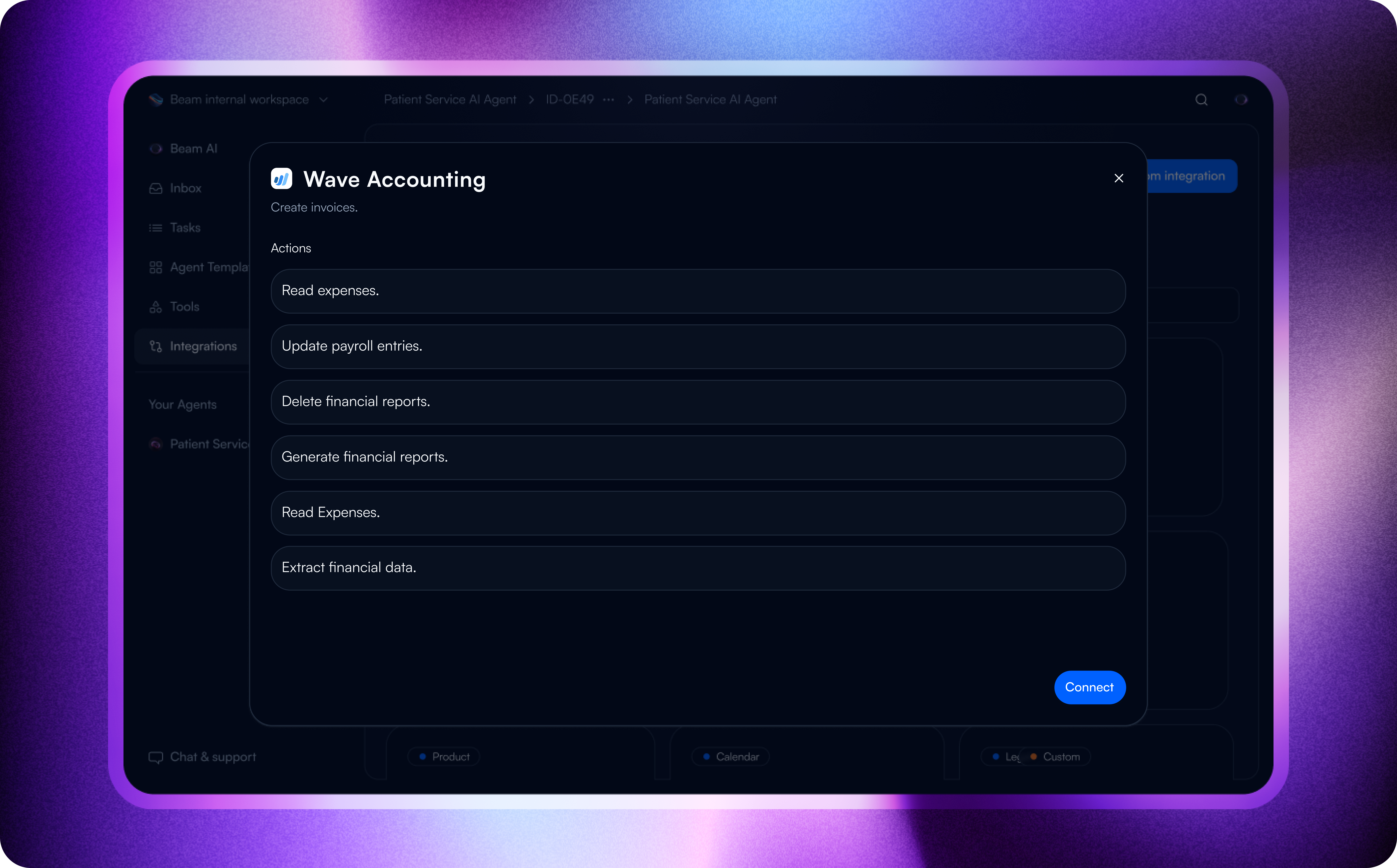
The useful starting point: Wave Accounting
Wave Accounting gives small-business finance teams a structured way to manage businesses, customers, invoices, products, and payments. For Beam, the starting point is a narrow, reviewable handoff rather than a promise to manage the whole process. For Wave, keep business, customer, invoice, and payment context together when a small-business finance owner reviews a record
How the workflow should behave
Use the product record as context, not as permission. Establish how the business enters review, what information Beam receives, and where the result is stored. Stop when the connector or account cannot support the documented rule
Examples for review
A sensible pilot begins when a business record is created, updated, or ready for review. Confirm the source record, required fields, and human owner before asking Beam to prepare any downstream action.
Once the pilot is understood, test a second path for business exceptions; keep the write-back operation narrowly scoped until it is verified.
Operational value
A concrete first use case for the product's documented resources.
Better visibility into the fields and permissions a workflow actually needs.
A rollout that preserves human judgment where the source does not define the answer.
Before you build
Check the connector's available read, write, search, notification, and event operations for your Beam workspace. Confirm the vendor authentication method, required scopes, plan limits, and any approval requirements. Treat the two workflow patterns above as designs to validate, not promises of universal coverage.